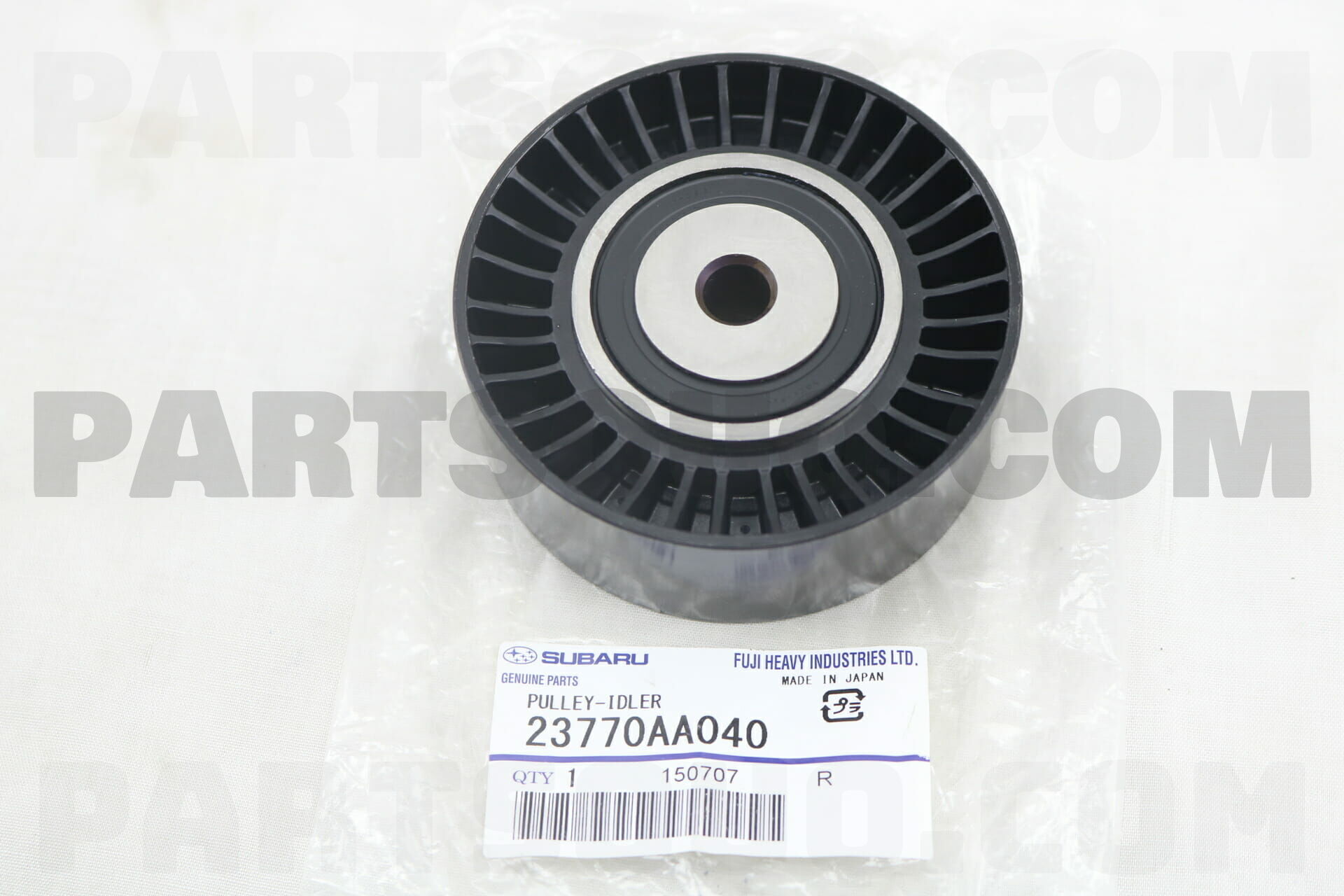
23770AA040 Subaru PULLEY-IDLER, Price: 28.65$, Weight: 0.345kg
| Make | Number | Name | Availability | Weight, kg | Ship in, Days | Price |
|---|---|---|---|---|---|---|
Subaru |
23770AA040 |
PULLEY-IDLER |
5 |
0.345 |
7-10 |
28.65$ |
Originals
| Make | Number | Name | Availability | Weight, kg | Processing, days | Price | |
|---|---|---|---|---|---|---|---|
| Subaru |
PULLEY-IDLER
|
6 |
0.397
|
2-3
|
24.57$
|
Compatibility
| Body | Made For Region | Engine | Vehicle Grade | Market | Model Year From | Model Year To | Diagram |
|---|---|---|---|---|---|---|---|
| WAGON | RHD | 2.0L DOHC TURBO DIESEL | TD-DEK | Europe/General | 08.2010 | 10.2012 | View |
| Body | Made For Region | Engine | Vehicle Grade | Market | Model Year From | Model Year To | Diagram |
|---|---|---|---|---|---|---|---|
| WAGON | RHD | 2000CC DOHC TURBO DIESEL | 20TDX('11MY-=20DX) | Europe/General | 03.2010 | 09.2011 | View |
| Body | Made For Region | Engine | Vehicle Grade | Market | Model Year From | Model Year To | Diagram |
|---|---|---|---|---|---|---|---|
| WAGON OUTBACK | LHD | 2000CC DOHC TURBO DIESEL | 20DSR | Europe/General | 05.2013 | 11.2014 | View |
| Body | Made For Region | Engine | Vehicle Grade | Market | Model Year From | Model Year To | Diagram |
|---|---|---|---|---|---|---|---|
| XUV | RHD | 2000CC DOHC TURBO DIESEL | 20DSR | Europe/General | 07.2013 | 03.2015 | View |
Engine Belt Idler Pulley (Subaru Fitment)
This pulley is a key guide wheel in the front engine belt drive. It keeps the belt running straight and tight while the crankshaft turns accessories like the alternator and A/C. Technicians replace it when the bearing gets noisy or the pulley surface wears. ✅
Why this part is needed
The belt must stay aligned at all RPM. The idler pulley supports belt routing, maintains correct wrap angle on other pulleys, and reduces belt flutter. Without a smooth idler, the belt can’t track properly. ⚙️
How it works
Inside the pulley is a sealed bearing that spins freely on its bolt while the belt rides on the outer ring. The bearing allows low-friction rotation, and the pulley face keeps the belt centered under load and temperature changes. 🔧
What happens if it breaks
A failing pulley often causes chirping, squealing, or grinding. If the bearing seizes, the belt can overheat, shred, or jump off. That may lead to loss of charging, weak cooling performance, power steering issues (if belt-driven), and sudden roadside breakdown. Replace at the first noise to avoid bigger damage. 🚗
Service tip
Always inspect belt condition and check for wobble or rough spin by hand during installation. 🛠️